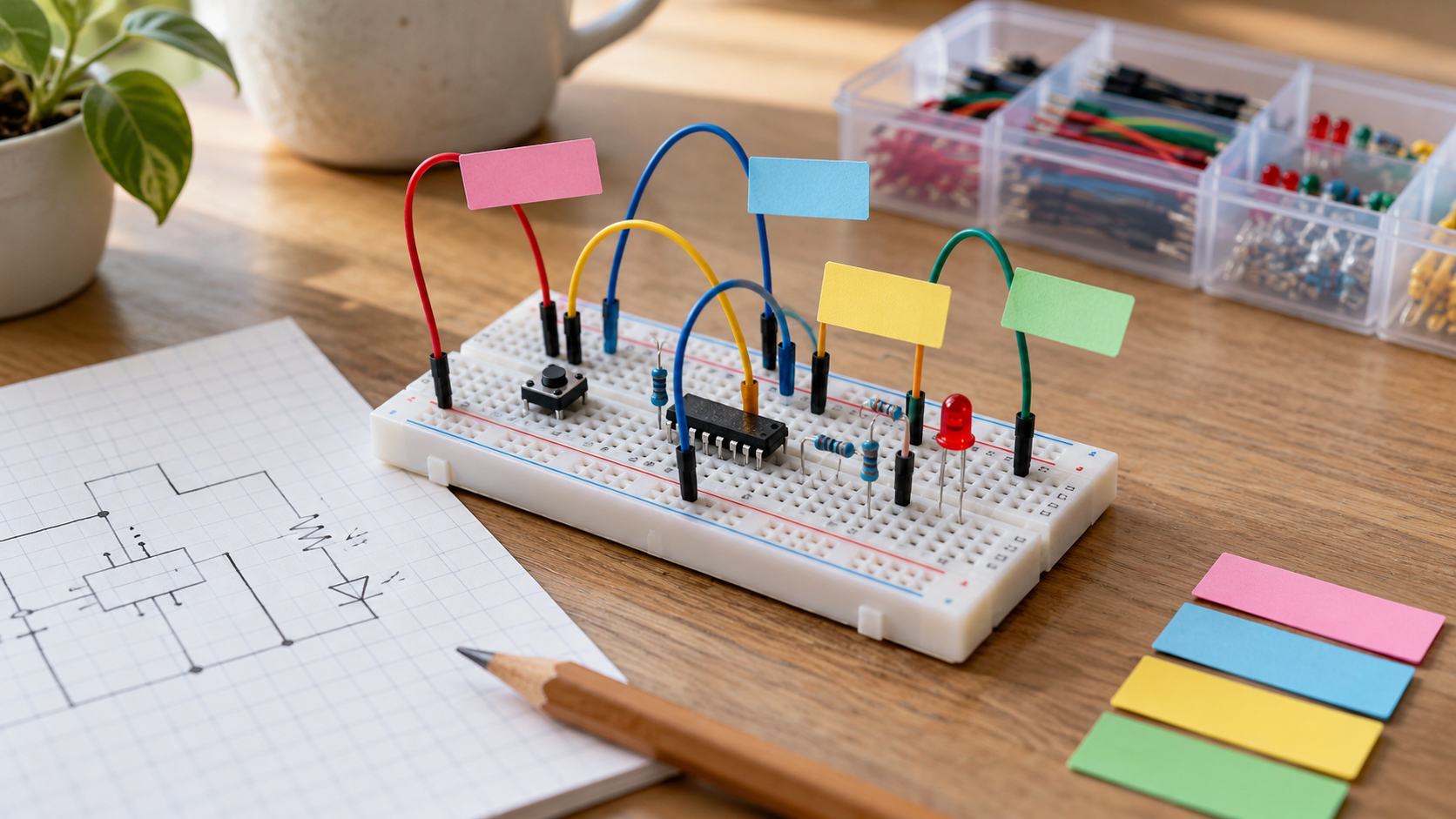
The drawing was clear. The connections were clear. The little pile of wires on the desk had received neither of those documents and was behaving as a separate administrative department.
I had taken careful notes about a small low-voltage prototype, then neglected to label the cable whose purpose would apparently remain obvious forever. Three evenings later, forever had expired. I spent an irritating amount of time reconstructing a decision that could have been recorded in one plain sentence.
The circuit diagram described a design. The label would have described this actual object on this actual desk. I needed both.
A short exchange with my previous self
Current me: What does this wire connect to?
Previous me: It is obvious.
Current me: That is not a connector name.
Previous me: You will remember.
Current me: Your confidence has not survived the weekend.
The exchange is imagined, but the administrative failure was extremely real. Technical competence does not make memory permanent. In my support work, a precise description of a small detail often saves more time than an impressive but incomplete account of the whole system.
I now name connections in language I can recognize later. The label refers to the role in the project, and the notebook records enough detail to locate that role. If I change a connection, I change its description too. A label that confidently describes an earlier version is worse than one that admits it needs checking.
The notes also identify the version of the prototype. A useful diagram can become misleading when the desk arrangement changes and the document does not. I date the revision and say what changed, keeping the description close to the actual work rather than relying on a grand final document I will supposedly write when everything is finished.
Put the information where the question happens
The label does not need to contain every technical detail. It needs to help me reach the correct detail. A simple project name or connection role can point to the relevant notebook page. The notebook supplies the fuller description. Each object has a manageable job.
I also photograph the unpowered prototype before putting it away. The photograph records orientation and layout that a quick drawing may simplify. It is a companion to the notes, not proof that every visible connection is correct. When returning to the project, I verify the actual arrangement before using it again.
These are small, low-voltage hobby projects. I keep hazardous electrical work outside the scope of casual desk experimentation and follow the relevant component and power-supply guidance. Neat labels do not magically make an unsuitable arrangement safe. They make an appropriate arrangement easier to understand and inspect.
The most useful test of the documentation is a pause. Put the project aside, work on something else, then return. Can I describe what it is supposed to do? Can I locate the current diagram? Can I explain the connection without needing to recover the mood in which I made it?
A friend once called labeling unglamorous. They were right. The little paper tag will never be the dramatic image in a project video. It is more likely to be the reason the next evening contains making instead of irritated detective work.
The impressive diagram remains in the notebook. The modest label remains on the object. My future self has stopped writing quite such sarcastic reviews of the arrangement.

A thought worth keeping?